Learning Sanskrit for the first time? Want to have a guide who can make the learning journey enjoyable? You have come to the right place! Here we will pick up learning Sanskrit from grounds-up.
Learning a new language can be a deeply enriching experience as language is an inseparable part of the culture and tradition. It has the timeless wisdom of sages, thinkers and writers who distilled their life experiences for future generations to reflect upon and benefit from.
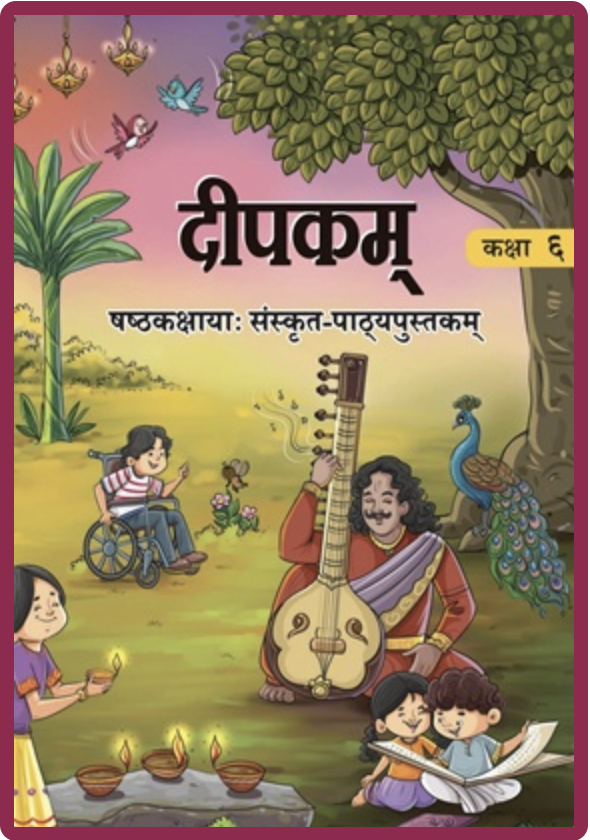
First things first – we will use a publicly available resource in India – NCERT text books as our primary source. Sanskrit is introduced first time in Class VI via text book named Deepakam meaning ‘lamp’ or a ‘light source’.
Second, a few necessary assumptions – that you have a good understanding of English – this will be our primary language of conversation. And you can read and understand basic Hindi – this is because Sanskrit is written in Devanagari script that is the same as for Hindi.
There is one more reason of bringing Hindi into picture, that is because the sentence construction of Sanskrit is mostly similar to Hindi, and slightly different from English. See below:
रमा पुस्तक पढ़ती है. Subject-Object-Verb
रमा पुस्तकं पठति. Subject-Object-Verb
Ramaa reads a book. Subject-Verb-Object
Here is how the course is structured. We will start with the basic building blocks of a sentence – grammatical case, forms of noun, pronoun, and verb. Then we will dive into Class 6 textbook, and go through the chapters in the order of appearance. Here is a glimpse of what to expect.
Usage tip: We will be using a lot of tables to view contents in this course, so it is preferred, to use a tablet or laptop computer for this course.
| Topic | Key learnings |
|---|---|
| Grammatical case (कारक) | Karakas define the relationship between nouns and verbs to provide the essential structural foundation of Sanskrit sentences |
| Forms of noun (संज्ञा रूप) | Noun forms in Sanskrit, known as शब्दरुप्, are declined across eight cases (विभक्ति) and three numbers to reflect their specific grammatical role within a sentence |
| Forms of pronoun (सर्वनाम रूप) | Sanskrit pronoun forms, or सर्वनाम रूप, are declined across seven grammatical cases and three numbers to indicate their relationship to the verb |
| Forms of verb (क्रिया रूप) | Sanskrit verb forms, or धातुरूप , are created from a root through 5 different moods/tenses (लकार) to precisely indicate the time, voice, and person of an action |
| Chapter Notes Structure | How each chapter notes are organized |
| Chapter 1: वयं वर्णमालां पठामः | Types of vowels and consonants, and grouping of alphabets based on place of articulation |
| Chapter 2: संयुक्त-व्यञ्जनानि | Conjunct consonants, letter combination and decomposition |
| Chapter 3: एषः कः? एषा का? एतत् किम्? | Basic sentence construction using noun, pronoun and verbs |
| Chapter 4: अहं च त्वं च | Basic sentence construction using pronouns – I and we |
| Chapter 5: संख्यागणना ननु सरला | Learning to count and numbers from 1 – 50 |
| Chapter 6: अहं प्रातः उत्तिष्ठामि | Learning to see and tell time |
| Chapter 7: शूराः वयं धीराः वयम् | Forms of He / She / It and I / You |
| Chapter 8: सः एव महान् चित्रकारः | Learning about colors, flowers, birds |
| Chapter 9: अतिथिदेवो भव | Use of unchangeable (अव्यय ) related to location – here, there, near, far, etc. |
| Chapter 10: बुद्धिः सर्वार्थसाधिका | Forms of verb and root word |
| Chapter 11: यः जानाति सः पण्डितः | Interesting riddles, and use of षष्ठी विभक्ति for relation or possession |
| Chapter 12: त्वम् आपणं गच्छ | Use of लोट् लकार form of verbs for imperative mood (command or wish) |
| Chapter 13: पृथिव्यां त्रीणि रत्नानि | Wise verses (सुभाषितानि) and their Word division (पदच्छेदः), Prose order (अन्वयः), Essence (भावार्थः) |
| Chapter 14: आलस्यं हि मनुष्याणां शरीरस्थः महान् रिपुः | Focus on usage of द्वितीया विभक्ति |
| Chapter 15: माधवस्य प्रियम् अङ्गम् | Learning names of body parts |
| Chapter 16: वृक्षाः सत्पुरुषाः इव | Some more wise verses (सुभाषितानि) and their Word division (पदच्छेदः), Prose order (अन्वयः), Essence (भावार्थः) |
Let us start with the most important building block for learning Sanskrit – the Grammatical case (कारक).